Showing posts with label death. Show all posts

Sunday, September 30, 2012

Bert

Last week, at the venerable age of nearly nine, our house rabbit Bert passed away as we fussed him.

Not a bad way to go really, when you think about it. Warm, dry, having your ears stroked, with fresh hay, vegetables and bunny treats within easy reach. I wouldn't mind ending my own days like that. He was a good age and, although cataracts and a spot of arthritis had taken their toll, he was still relatively sprightly, meandering round the garden hunting grapes and the occasional dandelion:


We'd known he was on his way out for most of the day and so were a little way prepared for the inevitable, but feeling his tiny body come to a stop with a small tremor and a bit of a stretch was quite the emotional wrench.

If you're not one of the privileged few fortunate enough to have had a house rabbit as a tenant, then you might think I'm being daft, but there you go. Emotions happened. Occasional tears were shed.

But then we've had him through some tough times over the last eight and a half years so perhaps not that surprising after all. He's been a fluffy constant at home through some of the highest peaks we've had, as well as being there through dark times, through those minor tragedies inherent to all of of us during our lives unless we're very, very lucky. Small wonder we will cling to whatever tiny rock, whatever small solace we can. Bert was, I now recall, a living, breathing source of succour and comfort.

Or at the very least a sock-shagging distraction.

Try being depressed with a randy bunny clinging to your Totes Toasties.

When I hear someone is thinking of getting a bunny type critter, I now implore them into making it a  house rabbit. That way, instead of a savage isolated bitey thing in an oft-neglected pen in the garden, they get a socialised, confident, very entertaining companion running circles around you whilst making soft honking sounds, leaping on to the walls and pushing off like a chinchilla in The Martrix, running up and down stairs ten times in a row for no other reason than it seems like the thing to do, or nudging your feet with his nose until you agree to fuss him for forty solid minutes whilst watching the telly.

His official title once our children came along was Officer In Charge Of Animal Appreciation, a duty he carried out with aplomb, supplying many hours of stoic fortitude as our children fussed him the wrong way, tried to pick him up, stuffed his ears into their mouths or pushed him along the floor like a living brush. Never biting, the most he would do when the attention got a little too much was hop off, occasionally showing his displeasure with a loud foot thump.

Bert's final duty was, as with many pets, to be an introduction to death. My five year old son became more aware of the ephemerality of life, that nothing lasts forever and even about the practicalities of being dead. We held a little burial ceremony, gave Bert some of his favourite treats in case there's a bunny Valhalla, wrote his name on the box, said thank you for being such a wonderful pet before burying him next to the lawn he'd frequented on sunny days for most of his life.

Demonstrating his newly acquired grasp of solemnity and respect for dead loved ones, my son turned to me and, in hushed tones, said "Daddy, I've just done a massive farp."

It comes to us all, son. It comes to us all.

And so a week after Bert left us I wanted to look at some photos of him, including the one above which is the last I took. Not to mourn him particularly because he was, at the end of the day, an old rabbit, but maybe as a little reminder that, for most of his time with us he was a bounding, leaping dervish who really did seem to enjoy being alive, to go wherever he pleased, and who fully considered our bed his own:

Sorry, no room for you on here. My stuff's on it.

A friend of mine quoted (perhaps inevitably) from Watership Down, suggesting Bert had been called by Frith and gone to dance with the black rabbit, which was poetry and sympathy in one fell swoop (thanks Jon). In the book, the black rabbit is an allegory for death as the rabbit's constant companion, and I like to think we protected Bert from that. I also feel he was a bit of an agnostic and so prefer the idea of him enjoying frith in the original sense of the word, where it means peacefulness and freedom from molestation.

He won't have his ears tugged by the children again, or have his apple stolen off him by a human toddler, or have his wood shavings piled up on top of him to "keep him warm". He won't be chased around the garden with a toy watering can, won't have a hat put on him and won't be taken to school for Show Your Pet Off day. I'll always admire his fortitude in staying serene in the face of children.

Of course, as a grown up medical professional, I felt that one should let a rabbit BE a rabbit, and would never stoop to such games solely for my entertainment.


Well, almost never.

Good night Bert.


Sunday, August 8, 2010

Karen Woo

The news has recently reported the tragic death in Afganistan of a young doctor whilst travelling back from treating patients in outlying regions.

Her name was Dr Karen Woo, and she had a blog, which I've just read.

It's good.

She died along with nine other people in what was either a robbery or a vague politico-religious assault, but was definitely an unjustified and deeply stupid attack showing an utter lack of respect for life by the perpetrators.

I have no supernatural faith, no religion, no belief in an afterlife, and I've never seen or read any evidence that humans have a soul or a spirit or any purpose other than that which we have created for ourselves, or that we are anything more or less than beautifully evolved biological mechanisms.

What we do have is a life.

Whatever happens, and for however long that life is, what can never be taken away is the simple fact that we existed, and will always have existed.

Taking life is far easier than preventing someone dying, and Dr Woo lived on the far side of the moral spectrum from her murderers.

Sometimes, I'm not lighthearted.

No apologies.

Sunday, November 22, 2009

Wet and not so wild

You may remember a post I did recently about cheering myself up with yellow things.

Yellow is good. Yellow is bright. Yellow is happy.

In that post I gave some examples of yellow things that are positive. Bananas, jaundice, Mr Custard.

Actually, not jaundice, unless you're positive for hepatitis. But definitely Mr Custard, the American Bullfrog at Slimbridge wildlife and wetland trust:

And yes, there may have been some labelling that Mr Custard might have drunk like a fish, hence his hue, but it was generally accepted that his yellowness was as a result of albinism, which isn't really his fault, no matter how you look at it.

We were there yesterday, and my son was relatively excited about seeing Mr Custard, saying "Want to see lellow prog!" three hundred and eleven times until we started to suspect that he might want to see the yellow frog.

Dutifully, we trudged towards the amphibian ghetto.

Imagine our distress when we were greeted by this sign:

Mr Custard had croaked.

And "retention of fluids"?

Looks like I was right about the . . . er . . . *makes drinky-drinky motion with hand*

My son was a little confused, but I think that, at two, he's ready for the "death talk".

It was going to happen soon anyway, what with my driving and the suicidal pheasants that abound round these parts, so I explained to him, in terms he could understand, that Mr Custard was no longer with us, and had gone to a better place. Possibly a heron's colon.

He got the message, and walked out with a new appreciation of life and it's adherent ephemerality.

"Lellow prog dead!" he announced as he strode past some other children, breaking them in easily for the sad news.

Luckily, Slimbridge has some other new American imports, which are proving to be a big attraction.

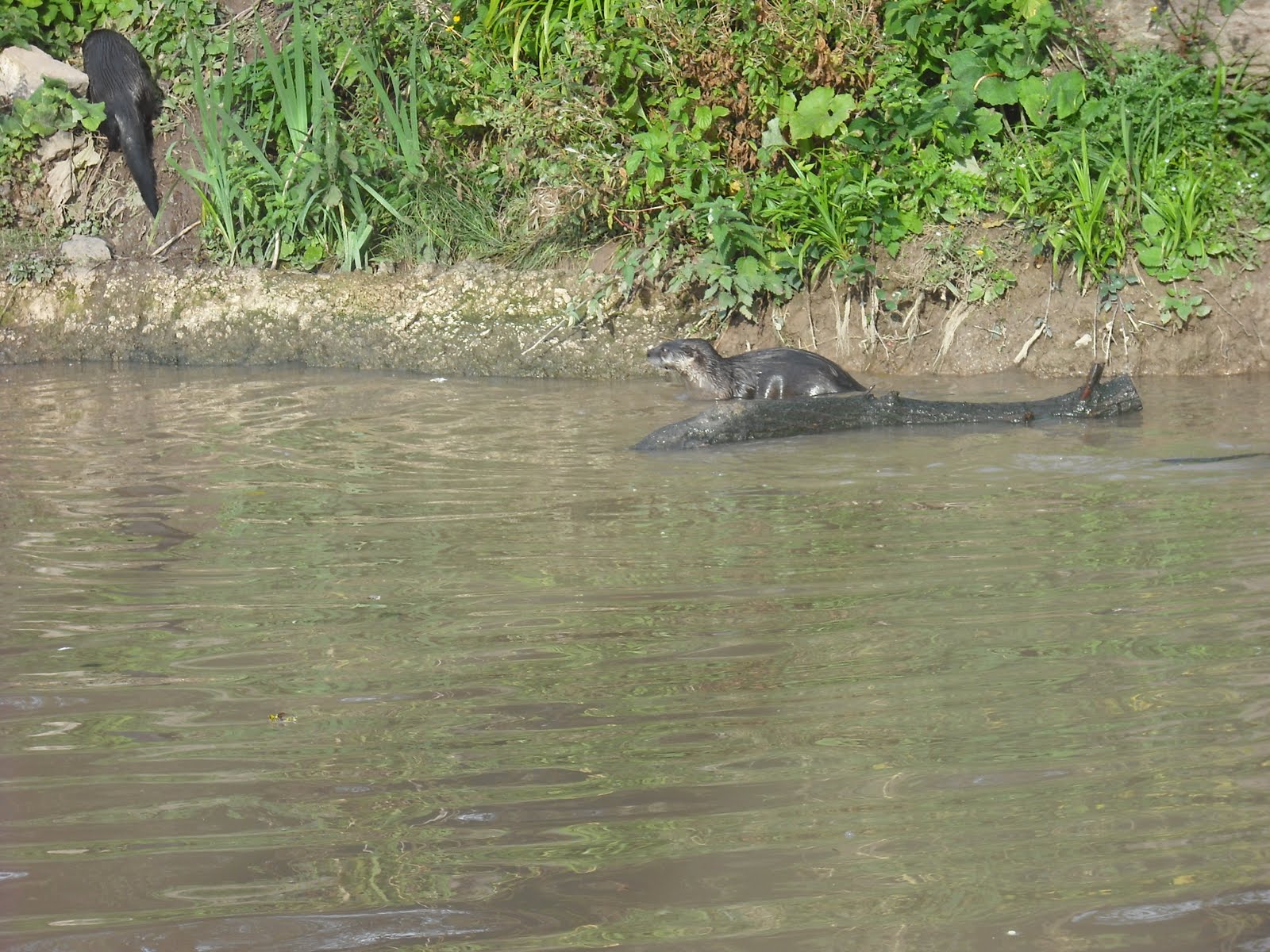
Otters:


These are North American otters, and although we do have a British version (the Eurasian otter), Slimbridge has these for a couple of reasons. The main one is that they needed a home, and they had one going spare. The other is that the American species is bigger, brasher, louder, more boisterous, likes showing off and doesn't mind being watched by an audience:


Typical yanks.

Despite being brown, the second saddest colour* otters are the embodiment of joi de vivre, and just the tonic for getting over the sad demise of Mr Custard. And the two, apart from both being American, are closer ecologically than one might at first suspect.

Apparently, otters eat frogs on a regular basis, so it all demonstrated the great, crunchy, chewy wonder that is the cycle of life.


* the first being puce, because nothing good is ever puce.

Friday, January 16, 2009

Thinking big

Entropy and decay - the unavoidable consequences of existence. This fragile life we lead sometimes leads one to a contemplative chain of thought, a private discourse on the nature of mortality and our place in the universe. Perhaps the ephemerality of our being leads us to draw conclusions that this is not all there is, that after death we are not merely snuffed out but continue in some way we don't understand. Or perhaps, we eschew these notions of life-after-death as mere wishful thinking and fear of dying, accepting that oblivion is the more likely endpoint. The universe doesn't need everlasting souls in some alternate dimension to operate; it worked for billions of years before us, it'll go on for billions afterwards.

And is there any point in thinking about "before" and "afterwards"? Is time simply a human construct for conveniently marking out our tiny, linear lives? Is it a single-dimension, distinct from space, divided into discrete "frames" that keep the cosmos in some sort of order, or is it an all-emcompassing oceanic ether through which we flow, affecting even the very gravity we need to exist?

These thoughts have been flickering through my mind recently, and it makes me consider the impact the world has on our consciousness, about how the greatest philosophers must have taken their muse from reality to formulate their hypotheses, the best minds must have been open to influence from their day-to-day lives.

And my conclusion? Well, the most profound thoughts I have ever had have been thought before, for thousands of years, by greater brains than mine. But that doesn't make my notions any less worthy, and I should not be afraid to articulate them.

I think I should clean my fruit bowl out a bit more often:

That, my friends, is a lemon. Next to the plum (I think).

Perhaps a close-up is required:


There's got to be a metaphor for life there, hasn't there?